
Honeywell Air Duct Cleaning in Miami: A Homeowner’s Guide
Honeywell doesn’t actually offer air duct cleaning services — they manufacture thermostats, air purifiers, media filters, and UV light systems that address symptoms of poor indoor air quality. In Miami’s humid climate, many homeowners install Honeywell whole-home filtration or UV systems expecting cleaner air, only to find the underlying problem persists because contaminated ductwork keeps recirculating pollutants. If you’re dealing with persistent dust, musty odors, or allergy symptoms despite running quality filtration, the ducts themselves likely need professional attention. Call Pinnacle Air Duct Cleaning Service Florida at (833) 858-4048 for a free assessment — we’ll tell you honestly whether cleaning, filtration upgrades, or both will solve your specific situation.
What Honeywell Actually Makes — and Where Duct Cleaning Fits
Honeywell’s residential product line covers four main categories: programmable and smart thermostats, portable and whole-home air purifiers, media air cleaners that install at your HVAC return, and UV light systems designed to inhibit mold and bacterial growth on cooling coils. Each product addresses a legitimate air quality concern, but none of them physically remove accumulated debris from the interior surfaces of your ductwork.
We’ve been cleaning ducts across Miami for 17 years, and we regularly encounter homes in Coral Gables and Pinecrest where homeowners spent $800–$1,500 on Honeywell whole-home filtration only to call us six months later frustrated. The filter was doing its job — trapping particles passing through it — but the ducts were still shedding construction dust, pet dander, and in Miami’s climate, mold spores that had colonized the sheet metal or flex duct interior years earlier. A premium filter upstream can’t stop contamination downstream that’s already embedded in the system.
Here’s the breakdown of what Honeywell equipment handles versus what it doesn’t:
- Media filters (like the Honeywell F100 or F300): Capture airborne particles at the return grille. Don’t address existing duct deposits.
- UV coil sanitizers: Prevent biological growth on wet evaporator coils. Don’t clean duct walls or kill mold already established in remote trunk lines.
- Whole-home dehumidistat integration: Helps control humidity that enables mold growth. Doesn’t remove existing contamination.
- Portable air purifiers: Clean air in single rooms. Don’t affect the central distribution system at all.
The gap is straightforward: Honeywell designs products to treat air passing through them. Professional duct cleaning removes the source material that’s continuously re-entering your air stream.
Why Miami’s Climate Makes This Distinction Critical
Miami’s average relative humidity hovers around 75% year-round, with summer months pushing 85% regularly. That moisture doesn’t stay outside — it enters your HVAC system every time the unit cycles, and the temperature differential between your 72°F supply air and 85°F attic ductwork creates condensation points throughout the system.
Honeywell UV systems are particularly popular in Miami-Dade County for this exact reason. Homeowners install them specifically to combat mold, and the technology does reduce microbial growth on coils where the light has direct line-of-sight. But here’s what we’ve observed in hundreds of Miami homes: UV installed on the coil doesn’t reach the dark, humid corners of duct runs in unconditioned attics or the sagging low points in flex duct where condensation pools.
We cleaned a system last month in a 1980s ranch near Palmetto Bay where the homeowner had installed Honeywell UV lights two years prior. The coil was clean — the UV had done that job — but the flex duct in the attic had three sagging sections holding standing water, and the interior lining was speckled with mold growth the UV couldn’t touch. The air passing through that ductwork was being “treated” by a $400 UV bulb, then immediately re-contaminated by 40 feet of moldy flex. That’s not a filtration problem; that’s a duct integrity and cleanliness problem that only physical cleaning and repair can solve.
In Miami specifically, we see this pattern repeat in homes near the coast where salt air accelerates corrosion, in older homes with original galvanized ductwork, and in properties that sat vacant during the pandemic with HVAC systems running minimally. The humidity here doesn’t forgive deferred maintenance.
How to Tell If You Have a Filtration Problem, a Duct Problem, or Both
This is the assessment we walk through with Miami homeowners who call us after investing in Honeywell or similar products without full resolution. The symptoms overlap, but the causes differ:
- Filter clogging every 3–4 weeks: Usually indicates high particulate load — could be duct debris being recirculated, or could be normal for your environment. Check: is the dust uniform, or does it spike after HVAC cycles?
- Musty odor when system first turns on: Strong indicator of biological growth in ducts or on coils. Filters don’t remove odors; UV only addresses where it shines. Persistent odor after UV installation suggests duct contamination.
- Uneven dust distribution — heavy near some vents, light near others: Points to duct leakage pulling attic air, or collapsed/separated duct sections. A filter can’t fix a disconnected return in a hot Miami attic.
- Allergy symptoms worse at home than outdoors, even with windows closed: Suggests indoor source. If you’ve upgraded filtration and symptoms persist, the reservoir is likely in the duct system itself.
- Visible debris or mold at vent registers: Definitive sign. What’s visible at the terminal point reflects conditions deeper in the system.
Our approach at Pinnacle starts with a camera inspection of the duct interior — we use Abatement Technologies inspection tools to show homeowners exactly what we’re seeing. In Miami’s market, we’ve learned that explaining the difference between a filtration gap and a contamination source saves homeowners from buying equipment they don’t need. Sometimes the answer is cleaning. Sometimes it’s sealing leaking ducts with Aeroseal or manual repair. Sometimes it’s both plus upgraded filtration. We don’t sell Honeywell products, so our assessment isn’t influenced by equipment margins — it’s based on what the camera and airflow testing actually show.
What Professional Duct Cleaning Covers That Product Installation Doesn’t
A Honeywell media filter or UV system installation is a point-of-equipment solution. Professional duct cleaning is a system-wide mechanical process. Here’s what that actually involves in our Miami work:
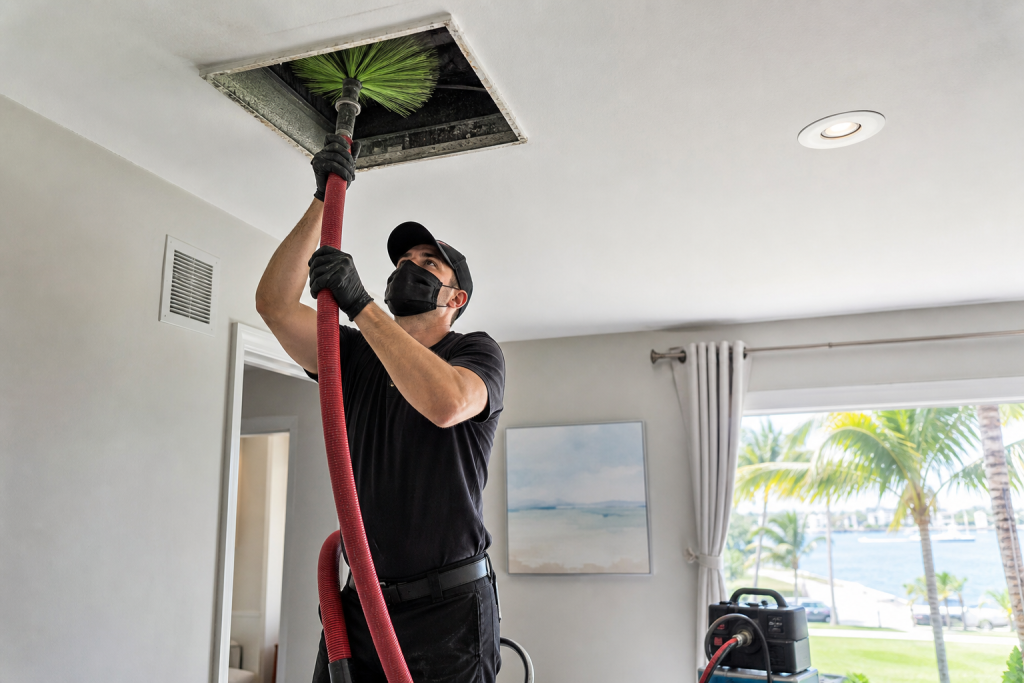
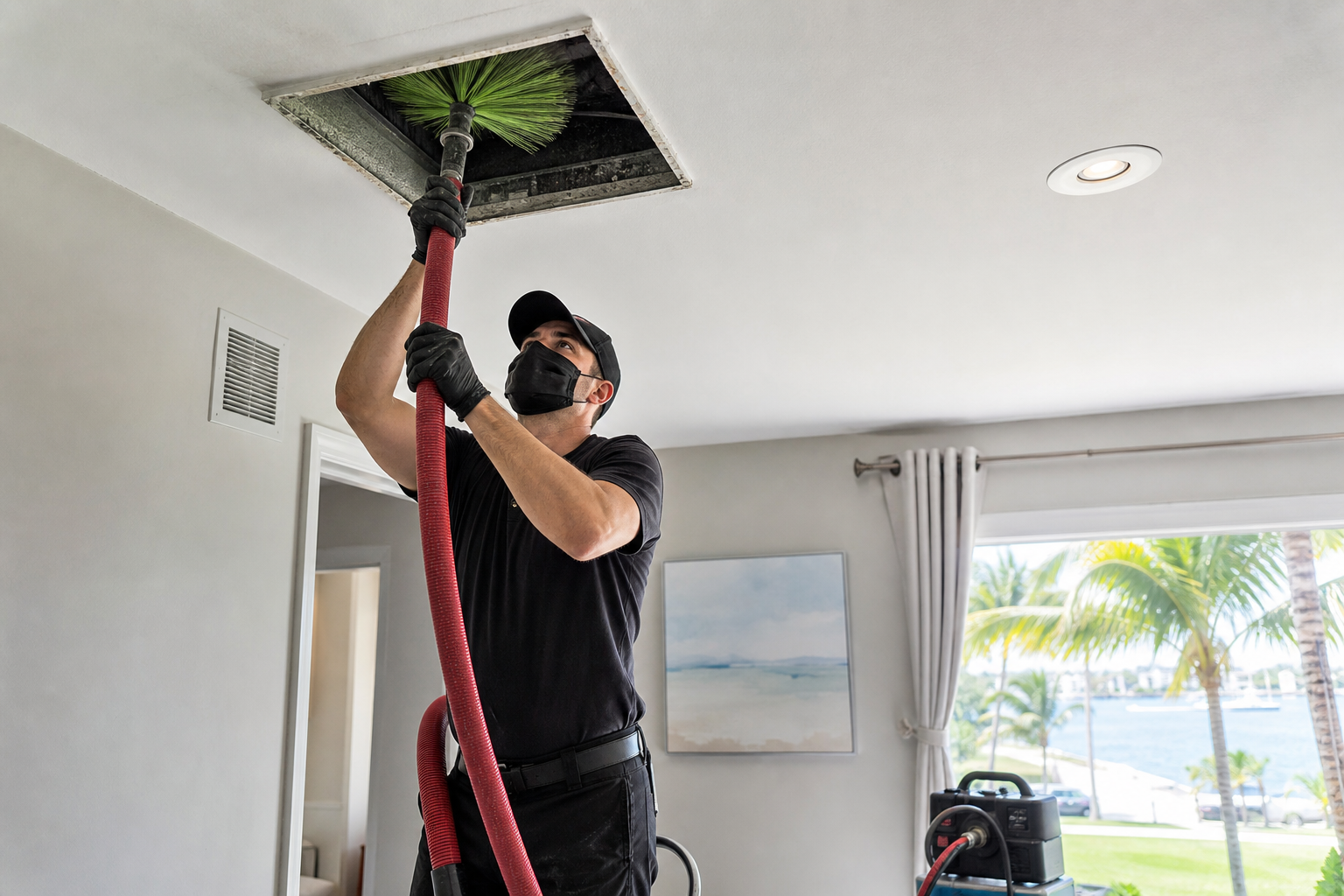
Mechanical agitation of duct surfaces: We use Rotobrush rotary brush systems — brush heads sized to the duct diameter — to physically dislodge adhered debris. In Miami’s older homes, especially in neighborhoods like Little Havana and Wynwood with original 1950s–60s construction, we’ve found layers of accumulated material including deteriorated duct liner, previous rodent activity, and construction debris from decades of renovations. No filter removes material that’s already stuck to duct walls.
Negative-pressure debris extraction: Our Nikro HEPA vacuum systems maintain 2,000+ CFM suction at the duct access point, capturing dislodged material before it enters your living space. This is where professional-grade equipment matters — shop vacuums and consumer-grade machines don’t maintain sealed negative pressure or true HEPA filtration.
Register and boot cleaning: The vent covers and short duct sections behind them are often the dirtiest points in the system, and they’re completely outside the path of any whole-home filter. We remove and clean each component individually.
Coil and blower cabinet access: Your Honeywell filter sits upstream of the coil, but the coil itself — and the blower wheel — accumulate debris that bypasses filtration or grows in the moist environment. We clean these components as part of our HVAC Cleaning in Williamsburg scope, which we apply identically in Miami.
Post-cleaning verification: We run camera documentation after cleaning and measure airflow improvements. In our 17 years, we’ve found that Miami homeowners appreciate seeing the difference — it’s more concrete than trusting that a new filter is “working better.”
The key distinction: product installation adds a component. Professional cleaning removes a problem. They’re not interchangeable, and in many Miami homes, they’re complementary — clean ducts first, then optimize filtration and humidity control with quality equipment.
When Honeywell Products and Duct Cleaning Work Together
We’re not here to dismiss Honeywell’s product line — we reference it because Miami homeowners are already buying it, often wisely. The strategic sequence matters:
- Start with assessment: Camera inspection and airflow testing to identify whether your problem is source contamination, distribution leakage, or filtration inadequacy.
- Clean if needed: Remove existing reservoirs of dust, mold, or debris before installing new equipment. Running a premium filter in a dirty system is like changing your car’s oil filter without changing the oil — the new component works harder and fails faster.
- Seal leaks: Miami’s attic temperatures exceed 130°F in summer. Leaky return ducts pull that hot, humid air into your system, overwhelming any filter’s capacity. We seal with manual methods or Aeroseal depending on access and duct type.
- Then upgrade components: Once the distribution system is clean and tight, Honeywell or Aprilaire whole-home filtration, properly sized, performs as designed. UV systems maintain clean coils instead of fighting upstream contamination.
We’ve applied this sequence in homes from Aventura to Cutler Bay. The homeowners who follow it — clean first, then optimize — report sustained improvement. Those who install first and clean later, or never, tend to cycle through increasingly expensive equipment searching for a solution that requires foundational work first.
Key Takeaways
- Honeywell manufactures filtration and control products, not duct cleaning services — searching “Honeywell air duct cleaning Miami” reflects a problem-solution mismatch that confuses many homeowners.
- Miami’s humidity makes duct contamination, especially mold, a distinct regional concern that filtration alone rarely resolves.
- UV systems treat surfaces they illuminate; they don’t clean duct interiors or remove accumulated debris.
- Professional duct cleaning provides mechanical removal, negative-pressure extraction, and system-wide access that no component installation can replicate.
- The most effective approach in Miami homes is often sequential: assess, clean and seal, then right-size filtration and humidity control.
When to Call a Pro
If you’ve installed Honeywell filtration or UV equipment and still notice dust accumulation, musty odors, or allergy symptoms that improve when you leave home, your ducts are the likely remaining source. Don’t buy a third air purifier — get the distribution system inspected. At Pinnacle, Charles leads every job himself, so the assessment you receive comes from 17 years of hands-on experience, not a sales script. We use Rotobrush and Nikro equipment — the same professional-grade tools used in remediation and restoration work — and we’ll show you camera footage of your actual duct conditions before recommending any service.
Related services in Miami: Beyond duct cleaning, we offer Dryer Vent Cleaning in Williamsburg (same methodology applied to your dryer’s exhaust system — critical for fire safety in humid climates where lint clumps), plus full HVAC cleaning, duct repair and sealing, and air quality sanitizing. Every service follows the same owner-led, equipment-serious approach.
The Bottom Line
Honeywell makes excellent air quality products, but no manufacturer makes a substitute for physically clean ductwork. In Miami’s demanding climate, the question isn’t whether to choose between filtration and cleaning — it’s whether your specific home needs one, the other, or both in the right order. We’ve built our business on answering that question honestly, with camera evidence and airflow data rather than pressure tactics.
If you’re in Miami and struggling to connect your air quality symptoms to the right solution, call Pinnacle Air Duct Cleaning Service Florida at (833) 858-4048. Charles Rodriguez handles the estimate personally, and we’ll tell you straight whether duct cleaning, sealing, or simply a better filter strategy is your best next step. Estimates are free, and we don’t sell equipment — so our recommendation is based entirely on what we find in your system.
Frequently Asked Questions
No. Honeywell is an equipment manufacturer, not a service provider. They produce thermostats, air purifiers, media filters, and UV light systems, but they do not clean ductwork. If you need professional duct cleaning in Miami, you’ll need to contact a specialized service company like Pinnacle Air Duct Cleaning Service Florida. Call (833) 858-4048 for a free estimate.
Portable and whole-home air purifiers treat the air passing through them, but they don’t remove contamination already adhered to duct walls. In Miami’s humid climate, mold and debris in your ductwork continuously re-enter the air stream, overwhelming what even quality filtration can handle. Professional duct cleaning removes the source material at its origin. Call (833) 858-4048 to schedule a camera inspection — estimates are free.
No. UV systems inhibit biological growth on surfaces they directly illuminate, typically the evaporator coil. They don’t reach the full length of duct runs, don’t remove accumulated dust or debris, and don’t address mold already established in remote duct sections. In Miami homes, we regularly find mold in duct areas UV can’t access. For a complete assessment of whether UV, cleaning, or both will solve your specific situation, call (833) 858-4048.
Start with symptoms and timing. If your home has persistent musty odors, visible debris at vents, or allergy symptoms that worsen when the HVAC runs, duct contamination is likely the primary issue. If your main concern is general dustiness with otherwise clean ducts, upgraded filtration may suffice. The definitive answer comes from a camera inspection of your duct interior — we offer this as part of our free estimate in Miami. Call (833) 858-4048 to schedule with Charles Rodriguez directly.
Written by Charles Rodriguez, Owner & Lead Technician at Pinnacle Air Duct Cleaning Service Florida, serving Miami since 2009.
Need Air Duct Cleaning Help?
Call Pinnacle Air Duct Cleaning Service Florida — licensed & insured, here with fast after-hours help in Florida.
(833) 858-4048